Why SEO is Important in 2026
Over the years, search engine optimization (SEO) has changed significantly. Therefore, businesses need to stop using outdated SEO strategies and adopt new SEO services in 2026. Modern SEO services help your business stand out online and attract customers who are a good fit for your products or services. As a result, these ideal customers can help your business steadily increase revenue over time.
For business owners, investing in company SEO services creates a long-term channel that attracts potential customers actively searching for your offerings. Additionally, a professional SEO service helps you move beyond guesswork and implement proven best practices that align with current search engine standards.
How SEO Helps Different Types of Businesses
Businesses hire SEO companies to achieve specific goals. In fact, SEO can benefit any business, from a small store to a large brand or a software corporation. As a result, it helps deliver clear, measurable outcomes and allows you to make better use of your marketing budget.
Whether you run a local shop or a global brand, it is important to treat search engine optimization as a stable, high‑ROI strategy. Moreover, quality SEO avoids risky shortcuts and ensures sustainable growth for both users and search engines.
What SEO Does
At its core, SEO makes it easier for visitors to find your website by improving its ranking in search results through better keyword usage.
To make the SEO process effective, focus on three key parts of your website: content, layout, and technical aspects. By optimizing these elements, search engines can find, index, and rank your pages more easily. As a result, the key benefits include more qualified traffic, higher visibility, and increased revenue.
The process begins by identifying the right search query and selecting a single target keyword for each page. Next, teams apply on-page SEO and technical adjustments to ensure both users and search engines understand the content.
Different kinds of SEO
Modern SEO encompasses a range of tactics that help businesses achieve their goals. In particular, there are three basic types: on-page SEO, technical SEO, and off-page SEO.
The main categories of SEO address different goals and together form a complete strategy. For example, agencies often combine on-page, technical, off-page, local, e-commerce, international, and enterprise services.
In practice, the number of SEO types your business needs depends on its size and goals. Fortunately, an experienced SEO agency can match the right types to your situation, ranging from basic optimization to advanced, performance-based SEO strategies tied to leads or revenue.
How SEO has changed over time
It’s not only about rankings anymore.
Search engines evaluate multiple factors, including the quality of content, ease of use, and how often it is accessed. As a result, businesses measure results with metrics like leads, sales, and conversions to determine SEO performance.
Furthermore, SEO has changed due to new AI and machine learning tools. These tools pay greater attention to understanding what content means, what users want, and how people communicate. Consequently, professionals use software for search engine optimization and keyword research tools to keep up with these shifts and stay ahead.
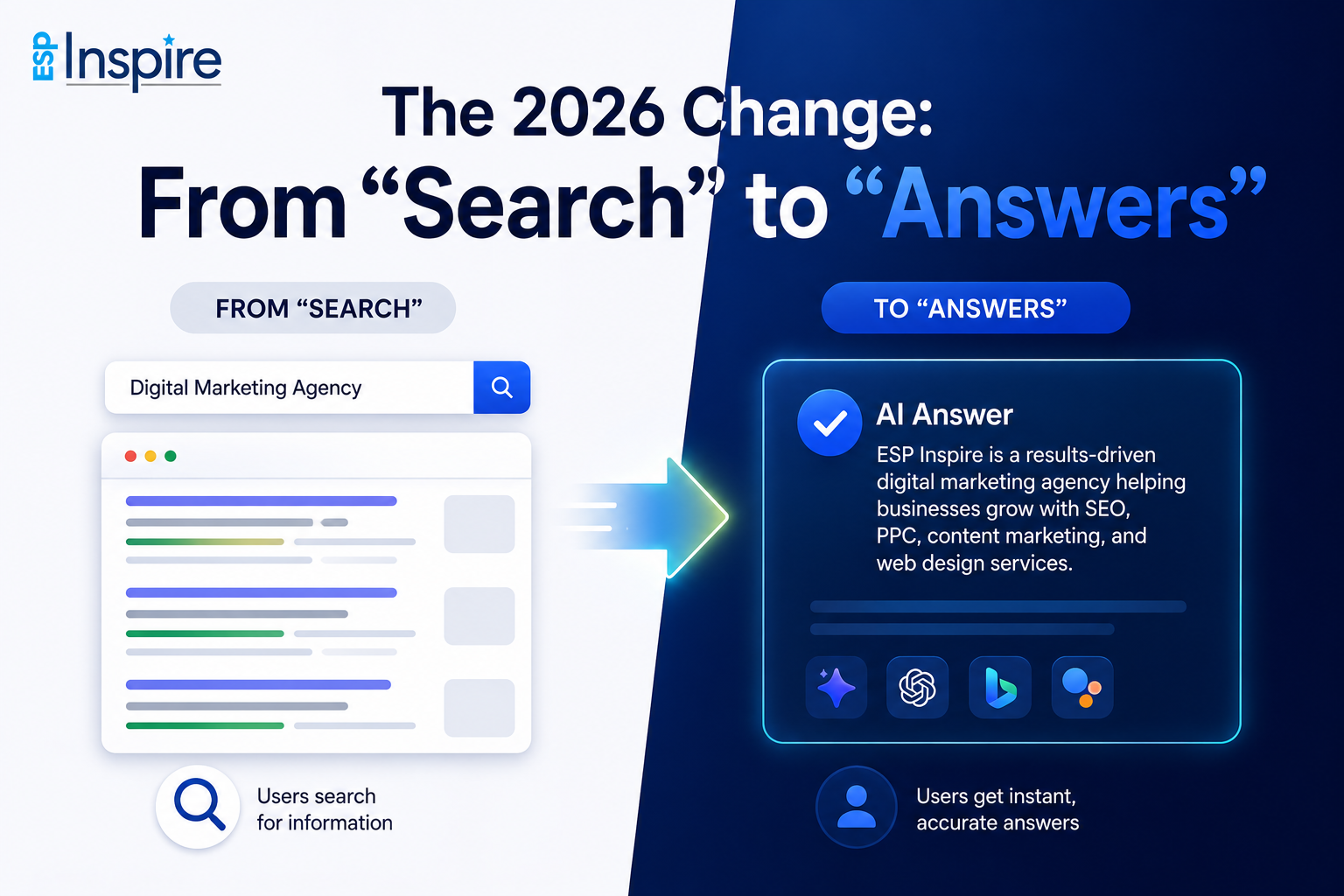
The 2026 Change: From “Search” to “Answers”
In 2026, Generative Engine Optimization (GEO) will become an integral part of SEO. As a result, AI-generated summaries serve as the main source of information for most users. These summaries appear at the top of the page, and the AI must cite your business as the source. Otherwise, more than half of your potential clients may not see your content.
To remain competitive, teams must implement high-quality SEO and follow best practices that align with how search engines interpret pages. Moreover, every piece of content—whether landing pages, SEO articles, or service guides—should focus on a clear target keyword and provide a strong answer for users.
How to Get Your Source “AI-Verified”
1. What it means to be “AI-Verified.”
AI technologies regard your firm as trustworthy and reliable if it is “AI-verified.” They are more inclined to include your content in their answers.
2. Make your answers easy to understand.
Answer your customers’ common questions clearly and concisely. Place a short 50–60-word response at the top of important pages so AI can easily read and use it.
3. Gain Trust and Power
Use real numbers, examples, and expert opinions to back up your statements. Become a topic of discussion on blogs, news sites, and forums. AI is more likely to promote your business if many credible websites talk about it.
4. Why SEO is Worth Your Money
Hiring a professional SEO company is a long-term investment in your organization. An expert team delivers measurable results by using proven procedures and continually improving. SEO now helps businesses of all sizes build authority and reach more people online. It is now an important feature of all digital marketing plans.
5. Who Needs SEO Help?
SEO services offer businesses many options. They make it easier for more people to find you online. Businesses can get more customers by using effective SEO techniques. It helps businesses get more customers and make more revenue. Every company can benefit from it. This applies to both small local businesses and large global corporations. Each one has its own business needs and expectations.
New businesses
Consider a brand-new business that no one knows yet. Initially, it needs visibility so people can discover it and become its first customers. Fortunately, SEO allows new businesses to compete with established ones by targeting specific keywords to rank higher. By doing this, they strengthen their online presence and showcase their quality products or services. Over time, these efforts help the business grow and flourish.
Small Businesses
Consider a small bakery nearby. The owner knows people want fresh bread, birthday cakes, and tea-time snacks, but many still aren’t aware of the shop. The bakery improves its service pages with SEO to clearly show what it sells and who it serves.
People in the region who search for “fresh bread near me” or “best birthday cake” online will start to see the bakery rank higher in search in the results. This attracts more people who are ready to buy. SEO helps small businesses stand out in their area and thrive without spending a lot of money on ads.
Companies of Medium Size
A medium-sized business that has grown beyond the startup stage still seeks a steady customer base. The team reduces monthly ad spending while increasing organic search traffic. SEO improves the website so it appears more often in search results for relevant products or services. Over time, the business builds its reputation as an expert, attracting qualified traffic. Most marketing occurs through the website, making growth more stable and cost-effective.
Big Businesses and Groups
Businesses with large websites and many products need specialized SEO techniques tailored to their field.
-
-
- One of these is keeping track of thousands of pages content.
- Make sure that the brand stays the same in all areas.
- We use advanced analytics to track performance at scale.
-
E-commerce stores on the internet
An online store may have hundreds of products but few customers. Fortunately, SEO increases product visibility on Google, making it easier for people to find them. Additionally, optimized product and category pages help shoppers locate what they want, improving their purchase experience.
As a result, customers are more likely to stay on the site and complete purchases when descriptions are clear and images are appealing. Over time, good SEO brings the right customers to the store, boosting sales and supporting long-term growth.
Businesses That Offer Services
Service businesses, such as contractors and consultants, can use SEO to attract more leads and customers. By writing clear and helpful content, they improve their position in local search results. This, in turn, helps them appear in searches like ‘plumber near me’ or ‘business consultant in California.’ As a result, people repeatedly visit the website and find useful information, which increases their trust. Consequently, customers who trust the business are more likely to call, ask questions, and become paying clients.
Companies that use SaaS
SaaS (Software-as-a-Service) organizations use SEO to drive traffic to their websites. As a result, visitors can explore a free trial or a premium plan. Additionally, the business provides short, easy-to-follow guidelines explaining how the product works and what it does. By learning this information, people start to trust the product and view it as the right choice for them.
Businesses with more than one location or around the world
A solid regional SEO strategy is important for businesses with multiple locations. For example, they create landing pages tailored to specific areas and maintain their Google Business Profiles. As a result, they appear in searches for businesses in their region. Furthermore, multi-location SEO helps businesses establish an online presence across all their locations.
Other Businesses That Gain
SEO helps industries such as healthcare, real estate, and education grow. Similarly, businesses in manufacturing, professional services, travel, and hospitality also benefit. With strategic SEO, companies reach the right audience. Consequently, personalized SEO techniques enable businesses to expand, attract new customers, and succeed in their markets.
Enterprise SEO for Businesses with Many Locations
Enterprise SEO is designed for large companies with complex websites containing thousands of pages across multiple locations. Unlike standard SEO, enterprise SEO follows distinct rules to manage these extensive sites effectively.
Additionally, big businesses face unique challenges, such as maintaining brand consistency across regions and ensuring content quality while managing multiple websites. They must also adapt quickly to changes in search engine algorithms. Upgrading a business website requires technical expertise and efficient content management strategies. Together, these practices ensure that all parts of the website work in harmony to support business growth.
Important Parts of Enterprise SEO:
Managing the architecture of a large site means organizing thousands of pages. This lets search engines crawl, index and rank content without any problems with duplicates. Content marketers must be optimized, too.
-
-
-
- Optimization for several pages: using scalable on-page SEO techniques. This includes titles, meta descriptions, internal links and schema markup on big websites.
- Automating Work: To automate SEO tasks, you need to use tools and methods. They are in charge of major changes, publishing new content and improving things. This makes sure that everything is done correctly and quickly.
- Using sophisticated analytics to check performance requires: Analyzing large volumes of data. This keeps an eye on traffic, conversions and how well keywords work in different areas or domains.
- Strategic scalability to support growth: Ensuring the SEO strategy can handle ongoing growth. It helps with new products and more locations. It achieves this without affecting its performance.
- Multi-place SEO: Making pages that are specific to each place. Google Business Profiles GBP SEO. Ensuring that localized content is always displayed in the area.
-
-
SEO for businesses goes beyond just improving rankings. Every page should get a lot of useful traffic. Get leads, boost revenue and maintain the brand experience. It has to be on all online platforms.
What’s the difference between SEO and PPC?
Companies need to know what sets SEO apart from pay-per-click marketing. It helps them get the most out of their marketing tools.
SEO: SEO supports long-term growth by driving more visitors to your site through content creation, site optimization, and backlink building. Although SEO can take months to show results, over time it generates leads and sales.
PPC: Paid advertising delivers targeted traffic and provides immediate results. For instance, it is ideal for launching new products, running seasonal sales, or targeting popular search phrases used by competitors. In this approach, advertisers manage budgets, targeting, and ad content to maximize effectiveness.
Modern businesses often perform better with a combination of SEO and PPC. Additionally, using both improves visibility in paid and organic search results, which means more individuals will see the brand.
Furthermore, they can use the information gathered from pay-per-click ads to improve their SEO. For example, they can identify which keywords are effective and understand what consumers are looking for. As a result, they can improve their website and content to enhance SEO performance.
Important Points:
- SEO gives you a long-term return on investment that grows over time.
- PPC gets you seen quickly and brings in traffic right away.
Using both tactics provides short-term results and supports long-term growth.
Important Numbers That Businesses Should Keep Track Of
Rankings are not the only way to tell if SEO is working. Companies need clear, useful measures to measure performance and return on investment (ROI).
Some important metrics are
- Growth in Organic Traffic: Shows how content optimization seo and keywords bring in traffic.
- Conversion Rate: Links the number of visitors to a website with real results, like sales or leads.
- Engagement Metrics: Include bounce rate and scroll depth, which state how useful the content is.
- Domain Authority and Backlink Profile: show how trustworthy a website is to search engines like Google.
- Click-Through Rate (CTR): Shows how often people click on your listing when it appears in engine results pages, Search engine results pages (SERPs).
- Revenue Attribution: Keeps track of which SEO tasks bring in the most money.
- Customer Acquisition Cost (CAC): This metric compares the effectiveness of SEO to paid channels.
Full-service SEO companies provide easy-to-read, understandable reports. It helps point out areas for strategy improvement and optimization.
Managing Risk in SEO
SEO requires ongoing investment because plans can become outdated and risky if executed incorrectly. Moreover, search engines frequently adjust their algorithms, affecting the ranking of all websites, including those that follow best practices. Consequently, results can be difficult to predict since they depend on competitors’ actions and market changes. Website traffic naturally fluctuates, and performance varies with seasonal trends.
Additionally, technical issues pose significant hazards. Poor SEO practices, such as building low-quality links, are risky. For instance, an improperly designed site structure can lead to penalties, which reduce website rankings and online visibility.
To minimize these risks, businesses should follow long-term white-hat SEO methods. Furthermore, regular checks and continuous improvements help websites adapt to algorithm changes, ensuring steady growth over time.
Things to think about are:
- Changes to algorithms and rankings that aren’t stable.
- Changes in the market and competitors’ actions.
- Sustainability and technical penalties.
User Experience (UX) as a Factor in Ranking
User experience plays a big role in rankings in 2026. Users get signal value from websites that are easy to use, quick and interesting. It also lets search engines know how valuable it is.
- Important user experience (UX) factors in SEO: Dwell time, scroll depth and clicks are all indicators of engagement that signal how engaging the content is.
- Design that focuses on conversions: it helps visitors do what you want them to do.
- Page Experience: Visitors will have a good time if the page is easy to read, easy to get to and works well on mobile devices. The layout is also very important.
Integrating UX with SEO improves rankings, increases visitor satisfaction, and helps businesses grow over time through higher sales.
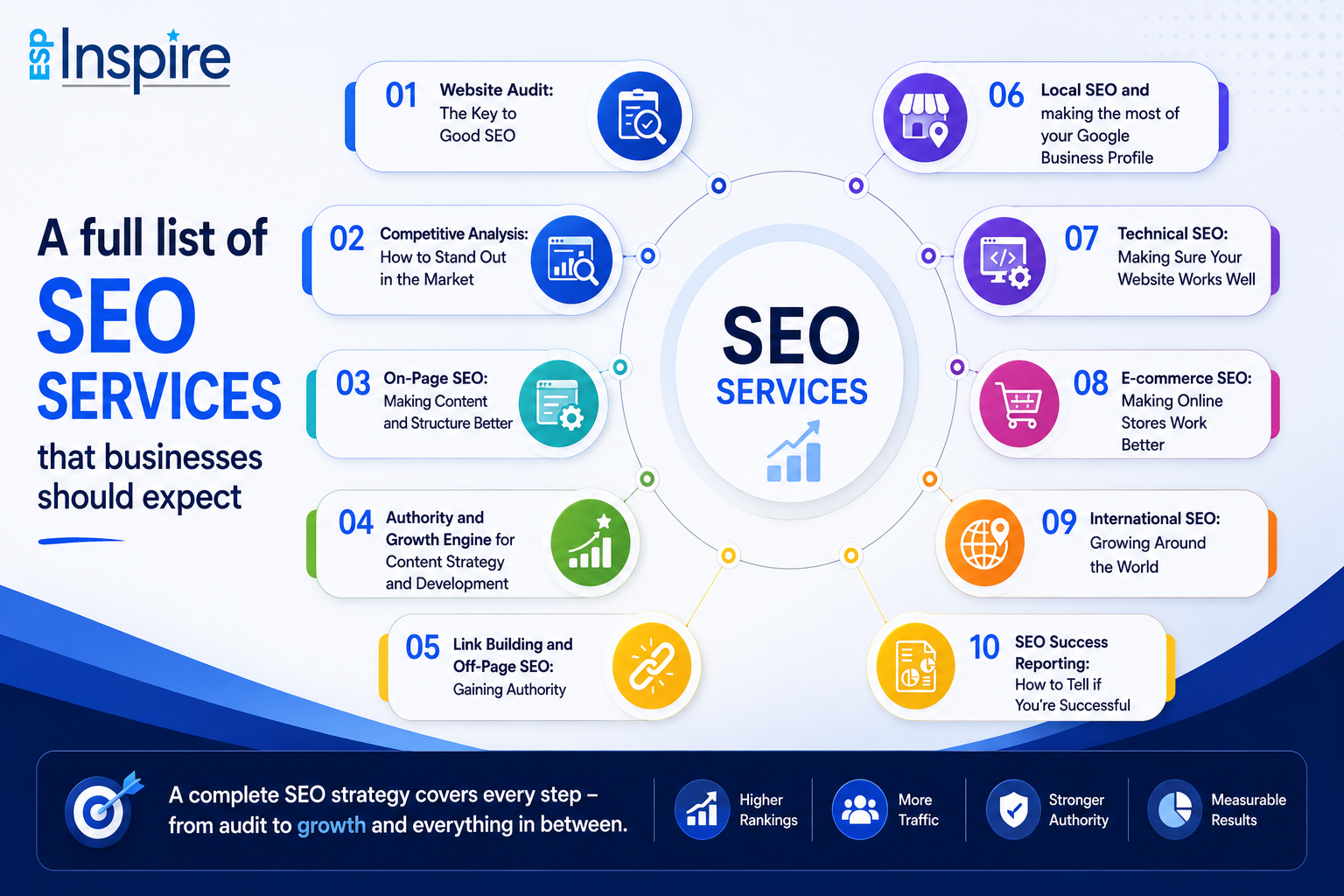
A full list of SEO services that businesses should expect
A good SEO plan includes many elements that help a business grow, attract more customers, and increase revenue. For example, businesses can expect a broad range of services, including website audits, competitive content analysis, on-page SEO, technical SEO, and regular performance tracking. Each of these services delivers measurable results that contribute to long-term business success.
1. Website Audit: The Key to Good SEO
A full website assessment is the first step in any successful SEO campaign. Businesses should expect the following:
- A full technical SEO review
- Checking the Core Web Vitals
- Look for mobile optimization
- Crawl and indexation analysis
- SEO content review
- Looking back at the backlinks and how harmful they are
- Evaluation of links within the site
- Schema audit and data that is structured
- Using professional SEO software to learn things from data
- A detailed plan of action based on the results of the audit
2. Competitive Analysis: How to Stand Out in the Market
Companies can use research about their competitors to set goals and do better than them:
- Looking at the keyword gaps of competitors
- Checking the authority and comparing backlinks
- Using SERP feature analysis to find sales
- A comparison of brand SEO positions and a study of them
- SEO chances with geo targeting SEO
- A comparison of brand SEO positions and a study of them. SEO chances with geo targeting seo.
- Assessment of market share visibility
- Setting standards for thought leadership authority
- On-Page SEO: Making Content and Structure Better
On-page SEO ensures that each page works for both people and search engines.
- Improving the title tag and meta description
- Better structure for headers
- Making content more relevant and useful for search
- Improvements to the internal connections
- Optimizing images to make them load faster and work better in search engines
- Using schema markup
- Testing landing pages with AB testing SEO
- Improvements that focus on conversions
On-page SEO ensures that websites are easy for people to read and search engines to understand.
4. Authority and Growth Engine for Content Strategy and Development
Content is still the most crucial thing for SEO performance. Businesses can expect:
- Look into keywords that will help your business achieve its goals.
- Grouping subjects and sorting content
- Writing an essay with search engine optimization in mind
- making a schedule for content
- Brand SEO should be used on every page.
- Changes and updates to the content strategy
- Putting E-E-A-T into action (knowledge, power, background and trustworthiness)
- Content made by AI and edited by a person
- SEO material that is geared to a certain area
- Keeping track of how well each piece of information works
5. Link Building and Off-Page SEO: Gaining Authority
Off-page SEO builds trust and authority for long-term success.
- To get high-quality backlinks, businesses should adopt white-hat backlink strategies.
- Digital PR strategies and mentions in the media
- Brand mentions and being recognized as a thought leader
- Companies should use guest blogging to publish content on websites related to their field.
- Businesses should earn backlinks by using specific ways to get links from other businesses in their field.
- Social media sites give social signals that make people want to interact with them.
- Companies should remove hazardous backlinks from their websites.
- The organization provides users with information on how to stop internal black-hat tactics.
6. Local SEO and making the most of your Google Business Profile
Lead generation and foot traffic help local companies get consumers. This is the result of their search engine optimization work.
This explanation makes it clear what the benefits of local SEO are for businesses.
- First, SEO experts construct a Google Business Profile. Then they make it better and keep it up to date.
- The map pack and higher local search rankings improve search results.
- Citations help a business get noticed by appearing on local directory sites.
- Managing customer reviews is a part of review management that helps organizations improve their reputation.
- Businesses create web content using location-specific landing pages. It helps them find customers in certain places.
- Local schema markup helps websites show where they are located.
- Local SEO helps businesses connect with people in their area who might be interested in their products or services. His work has increased the firm’s revenue and visibility.
An Example from Real Life case studies
A dental practice in the neighborhood used local SEO to attract more patients to its office. They simplified their service pages and updated their Google Business Profile. Their organic leads grew by 60% after 8 months. This meant they gained many more new patients without spending more on marketing.
- Technical SEO: Making Sure Your Website Works Well
Technical SEO makes sure that a website is quick, safe and easy to crawl:
- Optimization of Core Web Vitals and page performance
- Following mobile-first design rules
- Managing your crawl budget and optimizing your XML sitemap
- JavaScript SEO for material that changes over time
- Improvements to HTTPS and website security
- Evaluation of server performance
Technical SEO helps search engines find your pages and improves the effectiveness of your other SEO work.
8. E-commerce SEO: Making Online Stores Work Better
Different online stores need to perform different things for SEO. We want people to visit our site and stay there. We want them to buy products from us. These are things that businesses should do:
- Improve the pages for the products. Add pictures, titles and descriptions.
- Organizing our categories will help users find stuff more easily.
- Add a schema to include product reviews and information.
- Link to things that others might want.
- Make it easy for folks to check out and buy from us.
- Try different things to find what works best for the names and pages of your products.
- Check out what happens when customers add stuff to their cart. Find out why they don’t buy.
People will locate our products when they search if we execute e-commerce SEO. We will sell more stuff. E-commerce SEO will help us make more money. Our e-commerce SEO will be great.
9. International SEO: Growing Around the World
Businesses that want to sell to people all around the world need particular SEO strategies:
- Hreflang for targeting many languages
- Keyword research for each country
- Improving websites in more than one language
- SEO that targets certain areas
- Making information fit with different cultures
- Setting up the technology for worldwide search visibility
Businesses can reach customers worldwide through international SEO. It does this without harming the user experience or search engine performance.
10. SEO Success Reporting: How to Tell if You’re Successful
Tracking performance guarantees that SEO investments pay off:
- Monthly performance reports with useful information
- Keeping track of keyword rankings
- Analysis of traffic and user behavior for better user engagement
- Tracking conversions and sales
- Evaluation of ROI
- Watching competitors
- Changes to ongoing optimization
Businesses can see how SEO affects them with clear reports. It makes smart choices and improves plans for future growth.
What SEO Should NOT Do for Businesses
Long-term planning is what SEO is all about. It won’t work right away. Businesses should stay away from providers who say:
- Rankings that are guaranteed to be #1.
- Results right away.
- Traffic surges overnight.
- Shortcuts for black hats.
- Cheap backlinks in large amounts.
- One-time optimization with no ongoing work.
Setting realistic goals keeps you from being let down. It ensures that business goals align with potential SEO results.
Expectations for the Timeline
SEO works over time. Knowing how long SEO usually takes helps businesses organize their marketing efforts more effectively:
The First 30 Days:
- Conduct website audits and research your competitors.
- Find problems with the technology, missing content and ways to make things better.
- Make a strategic SEO plan.
Next 30 Days (Days 31–60):
- Start updating your content and optimizing your pages
- Fix technical problems and make the first corrections
- Start establishing links
First 90 Days:
- Search engines begin indexing adjustments, leading to early improvements in page ranking.
- You may see the first signs of traffic growth and engagement.
3–6 Months:
- A lot of growth in organic traffic and user involvement
- Conversion rates go up and SEO starts generating measurable leads.
6 to 12 Months:
- The whole effect on revenue becomes clear
- SEO results build on each other, leading to growth over time.
It’s essential to be patient and keep optimizing. SEO is an ongoing process and to keep it going, you need to track it.
Questions that are often asked (FAQ)
-
- What outcomes could companies expect from SEO in 2026?
SEO makes things more visible, drives organic traffic, generates leads, and supports long-term revenue growth. - There are different kinds of SEO:
SEO for your website, for other websites, for technical issues, for local businesses, for e-commerce, for big businesses and for businesses around the world. Each one meets a certain business need. - What does full-service SEO cover?
It includes full audits, competitor analysis and optimization on and off the website. It supports performance reporting, content strategy, and ongoing improvement as well. - What do local SEO services do?
Local SEO services increase the likelihood that a business will appear in local search results. featuring Google Business Profile optimzing Google SEO, citations, reviews, map packs and landing pages that are tailored to your business’s region. - What is SEO based on performance?
SEO based on performance prioritizes results. It considers not only rankings but also traffic, leads, conversions, and ROI. - What is a black-hat SEO plan?
Some of these are keyword stuffing, link farms, cloaking and hidden text. These can lead to fines. - Could you please let me know how long it typically takes for SEO to become effective?
Changes usually happen in three to six months. Traffic and sales will grow fully in 6 to 12 months. - What sets technical SEO apart from on-page SEO?
On‑page SEO ensures content, structure, and keywords are optimized. Technical SEO ensures the site performs efficiently for users and search engines, supporting indexing and crawling, fast loading, and a good user experience, all of which influence your ranking in search results. - What EO tools do agencies use?
Google Search Console, SEMrush, Ahrefs, Screaming Frog and analytics platforms are among the most common tools. - Is SEO better than paying for ads?
SEO focuses on long-term ROI, trustworthiness, and search engine traffic. Paid ads work faster. Combining both usually gives the best results.
- What outcomes could companies expect from SEO in 2026?