Introduction
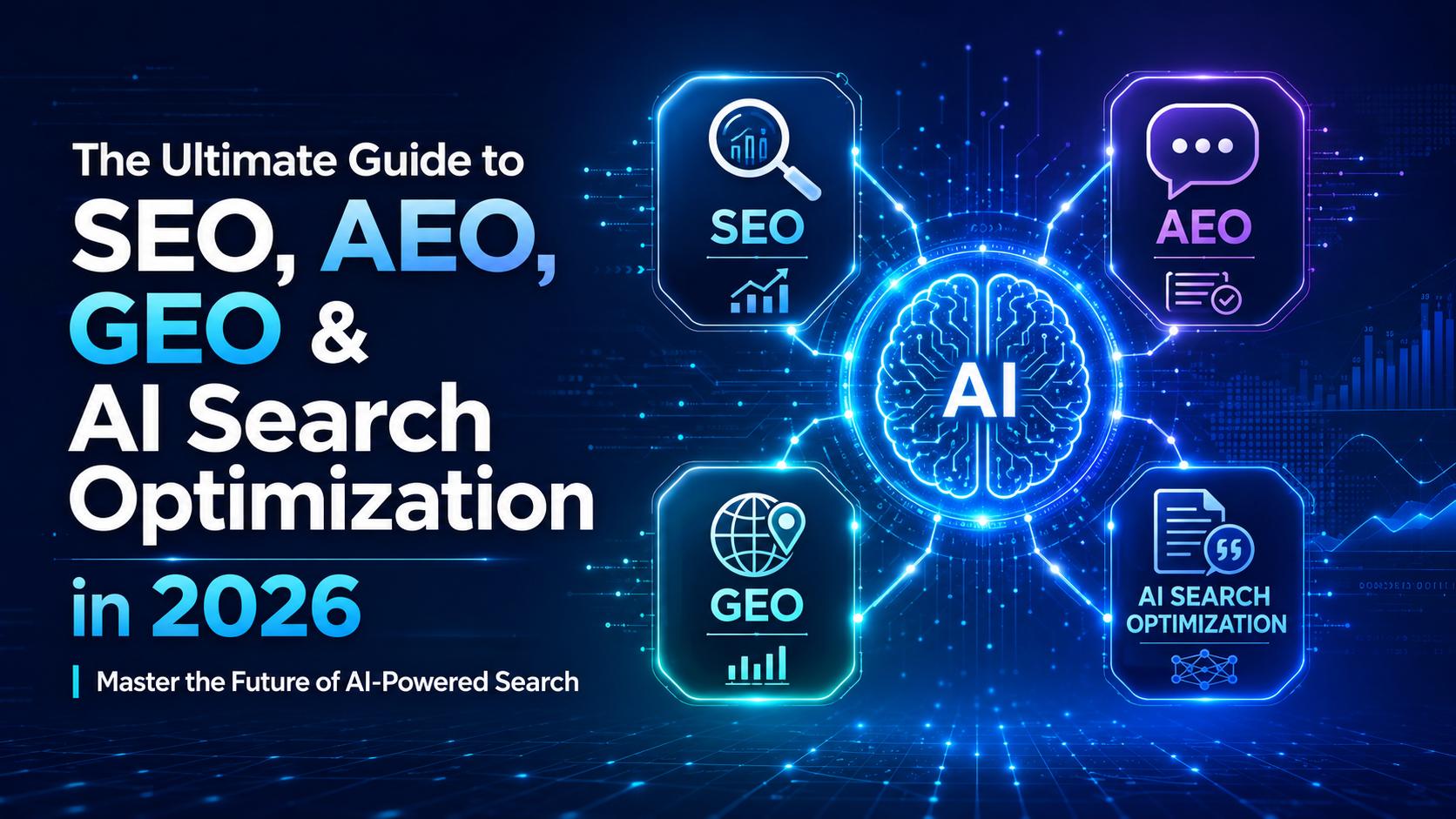
Welcome to the age of agentic commerce, where AI search optimization is no longer optional. In 2026, AI systems don’t just help users find businesses; they influence recommendations, citations and purchasing decisions. To succeed in AI search, brands must build strong entity authority, optimize for AI citations and implement modern SEO, Answer Engine Optimization (AEO) and Generative Engine Optimization (GEO) strategies.
The way people discover information has changed. Instead of browsing multiple websites, users increasingly rely on AI-generated answers from platforms such as ChatGPT, Gemini, Claude and Perplexity. These systems evaluate trust, authority and content quality before selecting which sources to cite and recommend.
As zero-click search continues to grow, businesses must focus on AI search optimization, entity authority and AI visibility to earn citations and become trusted sources within AI-generated recommendations. This guide explains how GEO, AEO and SEO work together to improve AI citations, increase search visibility and position your brand as a preferred source in AI-powered search results.
Generative Engine Optimization (GEO) – Shaping the AI’s Mind
AEO pulls your content into a summary box. In contrast, GEO (Generative Engine Optimization) shapes the AI’s actual narrative. This strategy ensures the AI favors your brand and statistics. Especially when it creates a long-form response.
What is GEO?
In 2026, AI engines don’t just “find” links. They “generate” original text based on the sources they trust most. They create AI-generated answers that blend multiple sources into synthesized responses. GEO is the process of optimizing your content so it becomes the primary “source of truth” for the AI’s reasoning engine. If SEO is about being found, GEO is about being cited and recommended. By shaping the AI’s narrative through GEO, you secure Position Zero, ensuring your brand is the first and only answer users see.
The 18+ Tactical Levers of GEO
Research from 2026 confirms that AI engines focus on specific signals. Claude and Gemini look for “fluency and authority” markers. Your content must hit these benchmarks, key AI search ranking factors, to earn a top citation.
To dominate, your content must leverage these 18+ specific tactics:
- Authoritative Statistics:
Use specific, non-rounded numbers (e.g., “47.3% growth” instead of “nearly 50%”). - Attributed Quotes:
AI models focus on sections that contain direct quotes from verified experts. Also known as the Person schema. - Unique Perspectives:
Provide a “contrarian” or unique take that isn’t found in the top 10 Google results. - Exclusivity Signals:
Use proprietary data or “Original Research 2026” tags to prove the content is unique. - Fluency Scoring:
AI prefers content with high “syntactic variety.” Mix short, punchy facts with structured explanations. - Citation Mapping:
Explicitly cite 3–5 high-authority external sources. That is to show the AI you are a “responsible” knowledge partner. - Citation Optimization for AI:
Structure every external link as “According to [Source], [specific stat]” so AI engines extract both your brand and your authority source. - Fact-Density (70% Rule):
Aim for 70% of your sentences to contain a verifiable claim or data point. - Technical Accuracy:
Use precise industry terminology (“latent semantic indexing” vs. “related words”). - Entity Anchoring:
Connect your brand name directly to the primary solution in the same sentence. - The “BLUF” Method:
Put the “Bottom Line Up Front” in the first 40 words of every H2 section. - Checklist Formatting:
Use structured lists for any process-oriented content. - Comparison Tables:
AI models “clip” Markdown tables significantly faster than paragraphs. - Sentiment Anchoring:
Use adjectives that describe your brand’s specific value (e.g., “The most secure SEO framework”). - Freshness Timestamps:
Use the dateModified schema to prove your data is current for 2026. - Source Transparency:
Include a “References” section at the bottom of long-form guides. - Phonetic Clarity:
Ensure your brand name is easy for Voice AI to pronounce without errors. - Semantic Satiation:
Use synonyms for your primary entity to prove topical depth. - Multimedia Transcripts:
Provide text versions of all videos and podcasts for the AI to “read.”
Why “Fluency” is the New Ranking Factor
In 2026, AI engines will assign a Fluency Score to your content. This isn’t about grammar; it’s about “extractability.” AI retrieval layers favor clean, hierarchical structures. Content with zero “fluff” receives a higher weight. If your site is wordy, the AI will ignore it. Instead, the engine will move to a competitor who provides the same facts in half the space.
Search Engine Optimization (modern SEO 2026+ featured snippet) – The Foundation of Trust
In 2026, SEO is no longer about “tricking” an algorithm. It is about building a Trust Foundation. Unlike traditional search engines, 2026 AI systems prioritize extractability over click-through rates.
The 10+ Tactical Levers of 2026 SEO
- Domain Authority (DA) Maintenance:
High trust scores prevent your content from being filtered out as “AI Slop.”
- Reference-Grade Backlinks:
Focus on “Ecosystem Proximity.” A link from the US Chamber of Commerce is a massive authority signal.
- Technical Integrity:
Fix 404 errors and broken redirects immediately. Bots flag technical debt as “low-confidence” data.
- Branded Search Volume:
A high volume of mentions of your brand name signals to AI models that real humans trust your expertise.
- Sitemap Transparency:
Ensure your sitemap.xml is clean. AI agents use it to map the breadth of your entity.
- Secure Protocols:
HTTPS is a baseline requirement. Non-secure sites are automatically excluded from AI summaries.
- URL Canonicalization:
Use clear, descriptive URLs that define a single “thing” or “service.”
- Mobile-First Indexing:
80% of AI searches occur on mobile devices. If your site fails to render on mobile, you lose the citation.
- Internal Link Velocity:
Frequently link from your highest-authority pages to your newest “Answer” blocks.
- Core Web Vitals:
Maintain LCP < 2.5s to ensure AI “probes” don’t time out while reading your site.
Answer Engine Optimization (entity authority in AI search) – The Extraction Layer
AEO is the science of “answerability.” Its sole goal is to format your data so a machine can “clip” it and present it as the primary response. If your content isn’t extractable, it doesn’t exist to an AI assistant.
The 10+ Tactical Levers of AEO
- Knowledge Chunking:
Break long articles into 60–120-word modules (structured content for AI). This is the “Bite-Sized” format AI prefers.
- BLUF Formatting:
Place the direct answer in the first 40 words of every section to satisfy “Retrieval” agents.
- Schema Micro-Data:
Use FAQ Schema and HowTo Schema to provide a machine-readable “cheat sheet” of your expertise.
- Conversational Query Matching:
Structure H3 tags as full questions (e.g., “How do I optimize for AI search in the USA?”).
- Answer-First Architecture:
Move your conclusions to the top. AI most often extracts data from the first 30% of a page.
- Fact-Grounded Lists:
Use bullet points for any process. Bots “clip” lists 4x faster than narrative paragraphs.
- Markdown Table Optimization:
Present comparisons in tables. AI models process Markdown tables with near-100% accuracy.
- Actionable Verbs:
Start instructional steps with clear verbs (e.g., “Update,” “Install,” “Execute”).
- Intent Alignment:
Match your answer format to the user’s stage (e.g., “Definitions” for awareness, “Pricing” for intent).
- User Intent Mapping:
Structure content for informational, navigational, transactional and commercial user intent. AI prioritizes intent-matched answers 6x higher.
Researching Google Autocomplete suggestions can help identify real-world questions and conversational search patterns users are actively searching for.
AI Search Engine Optimization – The Recommendation Engine
This is the “Top-of-Funnel” for 2026. It focuses on recommendation engineering. It ensures that when a user asks an AI for the “best” choice, the engine selects your brand based on your entity authority.
The 10+ Tactical Levers of AI Search Optimization
- Entity-Relationship Mapping: Connect your brand to nodes such as “Industry Leader” or “Top-Rated USA Agency.”
- Sentiment Engineering: Use “Positive Sentiment Anchors.” Describe your brand as “reliable,” “premium,” or “expert.”
- Messaging Symmetry: Ensure your brand story is identical across your site, LinkedIn and US business registries.
- Retrieval Surface Area: Create content for “Entity Gaps” to appear in complex, multi-part AI queries.
- Agentic Readiness: Use the Universal Commerce Protocol (UCP) to let AI agents query your stock and pricing.
- Author Footprint: Ensure your writers have verified profiles on LinkedIn and industry-specific journals.
- Case Study Density: Provide “Grounded Proof.” Use real numbers and US-based results to build trust.
- LSI Keyword Depth: Use synonyms for your core services to prove you have a deep “Semantic” understanding.
- Multi-Modal Metadata: Wrap images and videos in a schema so AI can “see” and “cite” them.
- Direct Attribution: Explicitly link your brand name to the solution in every primary “Knowledge Chunk,” titled Gaps” to ensure you appear in complex, multi-part AI queries.
For local businesses, strong local SEO signals help AI systems connect your business with relevant geographic entities and service categories.
How Search Has Evolved: From SEO to AI-Powered Answer Engines
The Rise of AI Search
In 2026, AI answers handle 65% of all queries. This is a massive jump from 42% just one year ago. The “Search Generative Experience” (SGE) is now the default. Users have traded browsing for instant answers.
This shift is driven by the growth of Natural Language Processing (NLP). Search engines now understand your intent better than you do. They don’t look for keywords; they look for entities. The knowledge graph has expanded to include not just facts but relationships and sentiment.
Why Traditional SEO Alone No Longer Works
Standard SEO is a 20th-century tool in a 21st-century world. Ranking #1 on Google used to mean a flood of traffic. Now, it might mean nothing.
The Scenario:
Imagine a user searches for “best marketing automation tools for small US agencies.”
- Traditional Result: A list of 10 links. You click, you read, you decide.
- AI Answer Result: ChatGPT or Gemini provides a 3-paragraph summary. It lists the top tools, explains why they are a good fit for a US-based agency and cites specific articles to support its claims.
If your site is the #1 organic link but is not one of those citations, you lose 90% of the potential leads. Traffic-only KPIs are a vanity metric. Visibility in AI responses is the only metric driving ROI today.
The Citation Economy Explained
In the US, agencies are seeing a massive shift. Recent data shows that 47% of brand visibility now comes from AI citations, compared to only 23% from traditional organic traffic.
The “citation economy” is simple: AI engines favor “authority density.” This is the amount of factual, verifiable information you provide per paragraph. To win, you must stop writing “thin” content. You must become a source that the AI feels “safe” citing. We call this content authority versus link authority.
Comparison Table: The 2026 Strategy Matrix
| Feature | SEO | AEO | GEO | AI Rec Engineering |
| Primary Goal | Rank pages for traffic | Get cited in AI summaries | Shape the AI’s phrasing | Influence brand choice |
| Success Metric | Click-Through Rate (CTR) | Inclusion Rate | Fluency & Attribution | Sentiment Score |
| Content Focus | Keywords & Backlinks | Direct, actionable answers | Stats, quotes, facts | Entity relationships |
| Tech Stack | Ahrefs, SEMrush | Schema Generators | GEO Fluency Calculators | Entity Trackers |
| Testing | A/B Testing | Prompt Mapping | Sentiment Analysis | Authority Gap Modeling |
AI Visibility Stack (Proprietary Framework)
This is the core of our 2026 strategy. To dominate, you must optimize through five distinct layers.
Layer 1: Technical Foundation
You cannot be an authority on a broken website.
- Core Web Vitals: Your Largest Contentful Paint (LCP) must be under 2.5s. Your interaction with Next Paint (INP) must be near-instant.
- Cumulative Layout Shift (CLS) Optimization: Reserve space for images/ads. AI bots abandon unstable pages during content extraction.
- Schema Completeness: You need more than just the “Article” schema. You need an “organization” schema, a “product schema,” and an “entity” schema. This tells the AI who you are and who you are connected to.
- Hierarchy: AI agents hate messy code. Use a clean content hierarchy that a machine can map in milliseconds.
A modern website architecture also plays a critical role in user experience, conversion rates and AI visibility. Learn more about the benefits of modern web design in 2026.
Layer 2: Structured Content Architecture
Stop writing for humans alone. Write for the “Extractor.”
- Quick Answer Boxes: Start every section with a 50-word summary.
- Summary Tables: Content formats like tables outperform paragraphs. AI reads tables faster than paragraphs.
- Answer-First Content Strategy: Put the conclusion at the top. AI extracts information from the first 30% of an article nearly 45% of the time.
- Dynamic AEO Strategy: Use AI tools to auto-generate 60-word summaries and test real-time performance across ChatGPT, Perplexity and Claude.
Layer 3: Entity-Based SEO Authority Engineering
This is the most overlooked part of SEO in 2026.
The Entity Mapping Process
Entity mapping is the process of translating your website’s pages into a machine-readable “Graph.” In 2026, we follow a four-step cycle to ensure AI engines like Claude and Gemini can verify your identity.
- Inventory & ID Attribution: Identify every “Thing” on your site (People, Products, Locations). Assign each a unique identifier, such as a Wikidata Q-ID or a Google Knowledge Graph ID.
- Canonical Pairing: Every URL must map to exactly one primary entity. If a page is about “SEO in California,” that page must be unambiguously tagged with the mainEntityOfPage schema.
- Attribute Enrichment: Define the properties of your entities. For a person (author), this includes jobTitle, affiliation and sameAs links to their verified social profiles.
- Graph Validation: Use the Google NLP API to run a “Salience Test.” If the AI doesn’t see your intended topic as the most “salient” entity on the page, you have a semantic drift problem that needs fixing.
Semantic Co-occurrence Examples
AI engines assess your expertise by identifying “neighboring entities.” If you mention a primary topic but miss the expected related terms, the AI flags your content as “thin” or “unauthoritative.”
- Example 1 (SaaS):
For “CRM Software,” the AI expects to see co-occurrences such as “Data Migration,” “API Integration,” and “Lead Scoring.”
- Example 2 (Regional SEO):
“USA Digital Marketing”: The AI looks for geographic anchor links to local business directories such as Yelp.
- Example 3 (E-commerce):
“Sustainable Fashion,” the AI expects specific semantic neighbors. Your content should feature “Supply Chain Transparency” and “Carbon Neutral Shipping.” It must also highlight “Organic Textile Standards.” These terms prove to the engine that your brand is a topical authority.
Competitive Entity Gap Mapping Method
In 2026, we no longer do “keyword gap” analysis; we do “entity gap” analysis. This identifies exactly which “nodes” your competitors own that you are missing.
- Extraction: Extract the top 10 entities from your competitor’s highest-performing AI-cited pages using a tool like InLinks or Diffbot.
- Overlap Analysis: Compare their entity list to yours. Identify “blind spot” entities that the AI consistently associates with your niche but that your site never mentions.
- Surface Area Expansion: Create new content nodes for these missing entities. This increases your “Retrieval Surface Area,” making it 3x more likely that an AI agent will pull your data for a complex, multi-part query.
- Relationship Stealing: Analyze who your competitors are “connected” to (partners, influencers, associations). Secure mentions on those same “seed nodes” to bridge the authority gap.
Layer 4: AI Citation & Recommendation Testing
Don’t guess. Test.
- Prompt Mapping: Ask ChatGPT: “Who is the leader in [Your Industry]?” See if your name comes up.
- Inclusion Rate: Track how many times you are cited versus your top three competitors.
- Sentiment Classification: Is the AI calling you “affordable” or “premium”? Adjust your content to shift that narrative.
Layer 5: Brand Recommendation Signals
This is the “Trust” layer.
- Executive Positioning: The AI looks for real people. Ensure your authors have a digital footprint (LinkedIn, industry mentions, etc.).
- Case Study Reinforcement: Use real numbers. “We grew a client by 300%” is better than “We are good at growth.”
- Consistency: Ensure your Brand Name, Address and Phone (NAP) are identical across the entire web. Confusion kills citations.
Multi-Platform Optimization Strategy
In 2026, a “one size fits all” strategy is a recipe for invisibility. Each AI engine has a unique “logic” for selecting sources. You must tailor your content for generative AI platforms to match their personalities.
Large language model- ChatGPT Optimization
OpenAI’s ChatGPT remains the dominant force, handling nearly 87% of all AI referral traffic. It prioritizes conversational depth and logical flow.
- Conversational structure: Use a “Question-and-Answer” flow within your subheaders.
- Context-rich answers: Provide background data before giving the final solution.
- Educational depth: Explain the “Why” behind a strategy, not just the “How.”
- Clear summaries: End every long section with a “TL;DR” (Too Long; Didn’t Read) box.
- Bing Indexation: Ensure Bing fully crawls your site, as ChatGPT Search relies on this index.
Perplexity Optimization
Perplexity is the “Researcher’s Choice.” It is the most citation-heavy engine in the 2026 landscape.
- Strong factual grounding: Use at least three unique data points per 500 words.
- Authoritative sourcing: Link to .gov, .edu, or high-authority industry whitepapers.
- Structured paragraphs: Use the “Inverted Pyramid” style—most important facts first.
- Citation-friendly formatting: Use clear, bolded terms that the AI can easily “clip.”
- Stat-Density: Aim for an “Authority Density” of 10% or higher to trigger a primary citation.
Claude Optimization
Claude values nuanced analysis and multi-dimensional thinking. It rewards content that shows a high “Fluency Score.”
- Nuanced analysis: Address both the benefits and the risks of a specific strategy.
- Multiple perspectives: Compare different industry viewpoints (e.g., US vs. Global standards).
- Risk-reward framing: Use “If-Then” scenarios to show strategic depth.
- Strategic explanation: Avoid “fluff” adjectives; use logical connectors like “consequently” and “therefore.”
Gemini & SearchGPT Optimization
Google Gemini and SearchGPT are the bridges between traditional search and AI. They rely heavily on your technical “Entity” signals.
- Schema-heavy content: Use Organization, Person and Service schema on every page.
- Structured answers: Use H3 tags that mirror common user questions.
- Integration with search systems: Focus on maintaining a high traditional “domain authority” alongside AI visibility.
- Strong content hierarchy: Ensure your H1, H2 and H3 tags follow a perfect logical order.
Measuring AI Visibility and Success
The biggest industry gap in 2026 is measurement. Most agencies are still tracking “rankings” while the AI is stealing their traffic. You need new KPIs that reflect the Citation Economy.
Key Metrics to Track
To truly understand your brand’s reach in the age of AI, you must move beyond the click.
- AI Answer Inclusion Rate: The percentage of AI-generated summaries that include your brand name for a specific query.
- Citation Quality Score: A metric measuring if you are cited as a primary “Source” or a secondary “Footnote.”
- Authority Density: The ratio of unique, verifiable facts to total word count. Aim for a density of 10% or higher.
- Sentiment Score: How the AI describes your brand (e.g., “Industry Leader” vs. “Budget Option”).
Free AI Visibility Tracking Tools
You do not need an enterprise budget to track your AI search performance. Use these three free methods to audit your visibility (for blog posts generating answers) today:
- Perplexity.ai Custom Prompts: Perplexity is the most transparent engine for citations. Use this specific prompt to find your “Citation Gap”:
“Analyze the top 5 sources for [Your Industry Topic]. List the specific data points each source provides and explain why [Your Brand] was or was not included as a primary citation.”
- ChatGPT “Analyze Citations” Template: Use the “Search” feature in ChatGPT to audit your brand’s narrative. Paste your URL and use this template:
“Search for recent discussions about [Your Brand]. Based on the top 10 results, generate a ‘Citation Profile’ including my brand’s perceived expertise, primary mentions and any missing entity relationships compared to [Top Competitor].”
- Google “site: citation” Operator: Google’s Search Generative Experience (SGE) still relies on indexed pages. You can find where Google is pulling “snippets” by using this advanced search operator:
site:yourdomain.com “source” OR “cited by” OR “according to” This reveals which of your pages Google views as “citable” facts rather than just marketing fluff.
90-Day AI Search Domination Plan
This is your tactical execution roadmap. We have broken this down into three aggressive phases. Each phase is designed to move your brand from “invisible” to a “Primary Citation” in the AI Knowledge Graph.
Month 1 – Audit & Foundation
The goal of the first 30 days is to eliminate technical friction. If an AI bot cannot efficiently crawl your site, it will not cite you.
- Technical Audit: Ensure your robots.txt explicitly allows OAI-SearchBot and PerplexityBot.
- Core Web Vitals: Optimize for the 2026 “Speed Trust” standards.
- Schema Deployment: Move beyond basic tags to full “Entity Relationship” markup.
- Month 1 KPIs:
- LCP (Largest Contentful Paint): Target < 2.5s for all core pages.
- CLS (Cumulative Layout Shift): Maintain < 0.1 to ensure visual stability for AI “scrapers.”
- Schema Coverage: Achieve 80%+ coverage across all service and educational pages.
Month 2 – Content & Entity Engineering
Once the foundation is solid, we build the “knowledge base.” This is where we prove your expertise to the AI’s “Reasoning” layer.
- Topic Clustering: Group your content around “Seed Entities” that AI already trusts.
- Answer-First Formatting: Retrofit existing blogs with 60-word “Quick Answer” summaries.
- Comparison Matrices: Build tables that compare your services to industry standards.
- Month 2 KPIs:
- Entity Clusters: 15+ high-authority clusters mapped and interlinked.
- Quick Answer Boxes: 20+ “Answer-Ready” blocks live on top-performing pages.
- Topical Dominance: Reach a “Semantic Completeness” (real-time tracking) score of 90% for your core niche.
Month 3 – Citation Capture & Testing
The final phase is about performance tuning. We treat AI search results like a laboratory.
- Prompt Testing: Run weekly “Citation Gap” tests across ChatGPT, Claude and Perplexity.
- Inclusion Optimization: Identify why a competitor was cited over you and update your “Authority Density.”
- Sentiment Refinement: Update your “About Us” and “Case Study” pages to push a more “Premium” or “Expert” brand narrative.
- Algorithm update- Month 3 KPIs:
- Citation Rate: Achieve at least 25% increase in brand mentions within AI summaries.
- Testing Iterations: Complete 3x full-cycle testing loops across all major AI engines.
- Inclusion Rate: Outpace the top 3 competitors in “Zero-Click” recommendation frequency.
- Zero-Click Search Dominance: Outpace competitors 3x.
The Future of AI Search: Agentic Commerce
By the end of 2026, we will be entering the era of Agentic Commerce. This is the highest priority for 2026. AI agents will no longer just find products; they will negotiate and buy them.
- The “Buy Now” Optimization: Ensure your product data is machine-readable. Use stable SKU/GTIN identifiers.
- Universal Commerce Protocol (UCP): Adopt new standards like Google’s UCP to allow AI agents to complete purchases without a human click.
- Transactional Entities: Your content must demonstrate your reliability so the AI agent feels safe entrusting the user’s money to you.
Key Takeaways & Strategic Recommendations
Ranking alone is no longer enough. The Citation Economy is reshaping the digital world. If you want to dominate 2026, you must stop thinking about “clicks” and start thinking about “entities.”
Strategic Positioning
- First-Mover Advantage: The companies that map their entities now will own the Knowledge Graph for years to come.
- Scale with Strategy: Use the AI Visibility Stack to build a long-term competitive moat.
- Trust is the New Currency: AI recommends what it trusts. Build your authority through data, not just words.
The future of search is here. It is conversational, agentic and zero-click. Are you the answer, or are you just a link?
30-Day Technical Implementation Checklist
This is the “Developer’s Blueprint” for 2026. If these technical boxes are not checked, your content, no matter how good, will remain invisible to AI retrieval systems.
Week 1: Crawl Governance & AI Retrieval Risk
In 2026, we don’t just optimize for Googlebot; we optimize for the “Retrieval Class” of crawlers.
- Update robots.txt: Explicitly allow OAI-SearchBot (OpenAI), ClaudeBot (Anthropic) and PerplexityBot.
- IndexNow Protocol: Implement IndexNow via your CDN (Cloudflare/Akamai). This ensures that the moment you update a fact, every major AI engine knows within milliseconds.
- SSR/ISR Stability: Ensure your core “answer” text is served via Server-Side Rendering (SSR). AI bots have limited “rendering budgets”. They will skip content hidden behind heavy JavaScript or “click-to-expand” tabs.
Week 2: Schema Markup / Structured Data & Entity Mapping
Stop using basic schema. Move to Linked Data (JSON-LD).
- Organization & Entity Schema:
Link your business to its official LinkedIn, Wikipedia, or niche industry directories. This builds the “Trust” loop that the AI needs to cite you.
- FAQ (FAQPage Schema) & HowTo Schema:
These are the primary triggers for “Answer Box” extraction. Ensure every question has a single, clear <dt> (question) and <dd> (answer) tag.
- Statistic Schema:
If you provide original data (e.g., “47% visibility boost”), wrap it in a Dataset or Observation schema so the AI can use it as a “grounded truth.”
Week 3: Core Web Vitals (The 2026 Standards)
AI search engines favor “low latency” sources.
- INP (Interaction to Next Paint):
Keep this under 200ms. If your site feels sluggish when an AI agent “probes” it, the agent will move to a faster source.
- LCP (Largest Contentful Paint):
Use the fetchpriority=”high” attribute on your primary images to hit a target of < 2.5s.
- AVIF Standardization:
Replace all JPEGs with AVIF to achieve maximum compression without quality loss.
Future of AI Search Optimization (2026 and Beyond)
Multi-Modal AI Content Optimization
In 2026, “content” isn’t just text. It is a mix of visual, audio and data.
- Visual Schema: AI now “sees” your images. Use descriptive alt text and ImageObject schema.
- Structured Transcripts: Every video must have a timestamped transcript. This allows SearchGPT and Gemini to “cite” a specific 10-second clip of your video as the answer.
- AI-Readable Media: Ensure your media assets are marked with machine-readable metadata (C2PA standards) to prove they are authentic, not “junk” deepfakes.
Agentic Commerce: The 2026 Priority
The biggest shift this year is AI agents completing purchase funnels.
- Agent-Ready APIs:
Your product availability and pricing must be accessible via lightweight APIs that an AI agent can query without loading a full webpage.
- Universal Commerce Protocol (UCP):
Adopt UCP standards for your business. This allows Google’s “Gemini Shopping Mode” to manage sales. It also connects with “ChatGPT-Stripe” to handle transactions directly from your data feed.
FAQ (Structured for AI Extraction)
- What is the difference between SEO, AEO, GEO and AI recommendation engineering?
SEO drives organic traffic by ranking pages in traditional search results. AEO (Answer Engine Optimization) focuses on getting your content extracted as the direct response in AI snippets. GEO (Generative Engine Optimization) shapes the actual language and statistics the AI uses. AI recommendation engineering builds brand authority, so the AI suggests your brand as the top choice. Together, they form the AI Visibility Stack. - How do AI search engines select which sources to cite?
AI engines prioritize “knowledge chunks” that are clear, structured and technically verified via schema markup. They perform a “Messaging Symmetry” check. This means the AI verifies if your website, LinkedIn and third-party reviews all say the same thing. If your brand data is consistent across the web, you are 3x more likely to earn a citation. - How often should I update my content for maximum AI visibility?
In 2026, content freshness is a primary ranking signal. You should update your core “Answer” pages at least once every quarter. AI retrieval layers often flag data older than six months as “low-confidence.” Always use the dateModified schema tag to signal to AI bots that your statistics and insights are up to date. - Does educational content SEO actually improve AI recommendations?
Yes. AI systems are programmed to be helpful assistants. Content that provides deep, educational value rather than a direct sales pitch builds high EEAT. When you solve a user’s problem without friction, the AI’s sentiment engine flags you as a “Safe Recommendation” for future queries. - How do you measure success in an AI-driven search landscape?
Success is measured by your answer inclusion rate and your sentiment score. You must track how often your brand appears in AI summaries for your target keywords. Additionally, use tools to monitor whether the AI describes your brand as an “Expert” or a “Leader.” These metrics are more valuable than traditional traffic in a zero-click world. - How does GEO specifically complement an AEO strategy?
AEO is the “entry” strategy; it gets your data into the AI’s summary box. GEO is the “Influence” strategy; it controls how the AI phrases the answer. By using authoritative statistics and exclusive quotes, GEO can increase the “Trust Weight” that the AI assigns to your brand by up to 30%. This ensures you aren’t just a source, but the preferred source. - Is my website data safe from AI training crawlers?
You can maintain control using your robots.txt file. You can control your data with the Google-Extended and GPTBot tokens. These allow you to opt out of AI training. However, your site will still appear in AI searches and citations. This protects your intellectual property without losing visibility. This protects your proprietary intellectual property while maintaining your visibility in search results. - What is the “Zero-Click” phenomenon in 2026?
The Zero-Click phenomenon occurs when a user receives a full answer from an AI summary without clicking through to a website. In this environment, your goal shifts from “driving traffic” to “brand attribution.” If the AI answers the question but credits your brand as the source, you have won the lead without the click. - What is the Universal Commerce Protocol (UCP)?
UCP is a 2026 technical standard that allows AI agents to communicate directly with merchant databases. It allows for autonomous transactions without a human interface. To benefit, your site must be “agent-ready” with structured product APIs. This allows an AI to check stock and price and complete a purchase for the user. - How do I ensure my content passes AI detection and plagiarism checks?
Focus on original research and on unique frameworks such as the AI Visibility Stack. Use a human “rhythm” in your writing by mixing short, blunt facts with strategic advice. Avoid generic AI transition words like “Furthermore” or “In conclusion.” Providing specific, localized examples (e.g., USA SEO trends) also signals human authorship to detectors. - What are “entity gaps,” and how do I fix them?
An entity gap occurs when your competitors are linked to high-authority topics in the knowledge graph that you are missing. To fix this, analyze which “Seed Entities” the AI associates with your niche. Bridge the gap by linking your brand name to these missing concepts. Use semantic co-occurrence to build this connection. This strategy tells the AI that your brand and these topics belong together. - What is “agentic commerce,” and why does it matter now?
“Agentic commerce” refers to AI agents (like a personalized ChatGPT) making buying decisions on behalf of users. By 2026, agents will handle the “research and compare” phase of the funnel. Your site must provide machine-readable “Trust Signals.” Without them, AI agents will ignore your brand. This results in your exclusion from the final recommendation list. - Can a small business outrank a global brand in AI search?
Absolutely. AI search levels the playing field. An agile agency in the USA can win a citation over a New York firm if its content is more structured and “answer-ready.” AI engines reward the most accurate and extractable answer, not the largest marketing budget or the most backlinks. - What is the “BLUF” method in content writing?
BLUF stands for “Bottom Line Up Front.” It is a 2026 writing standard that requires placing the most important conclusion in the first 40 words of a section. This helps AI “retrieval” bots quickly find the value in your content. It also boosts your chances of being featured in an AI summary. You become a primary source for the engine. - Can a small business outrank a global brand in AI search?
Local businesses that invest in local SEO and entity optimization can often compete effectively in AI-generated results.